
🎓 TERM 1 COURSE | 6 WEEKS | SELF-PACED
Transform your Caribbean harvest into profitable, shelf-stable products. Learn processing techniques, food safety, packaging, pricing, and market access — from farm gate to supermarket shelf.
⏱ 6 weeks of content
💻 Self-paced + weekly cohort check-ins
📜 Certificate of Completion Included
🌍 Caribbean-Focused Curriculum
👥 Community Access Included
$97 one-time (Payment plans available)
Founding Member Bundle: Any 3 Term 1 courses for $197
✓ Lifetime Access ✓ Downloadable Resources ✓ Expert Instruction
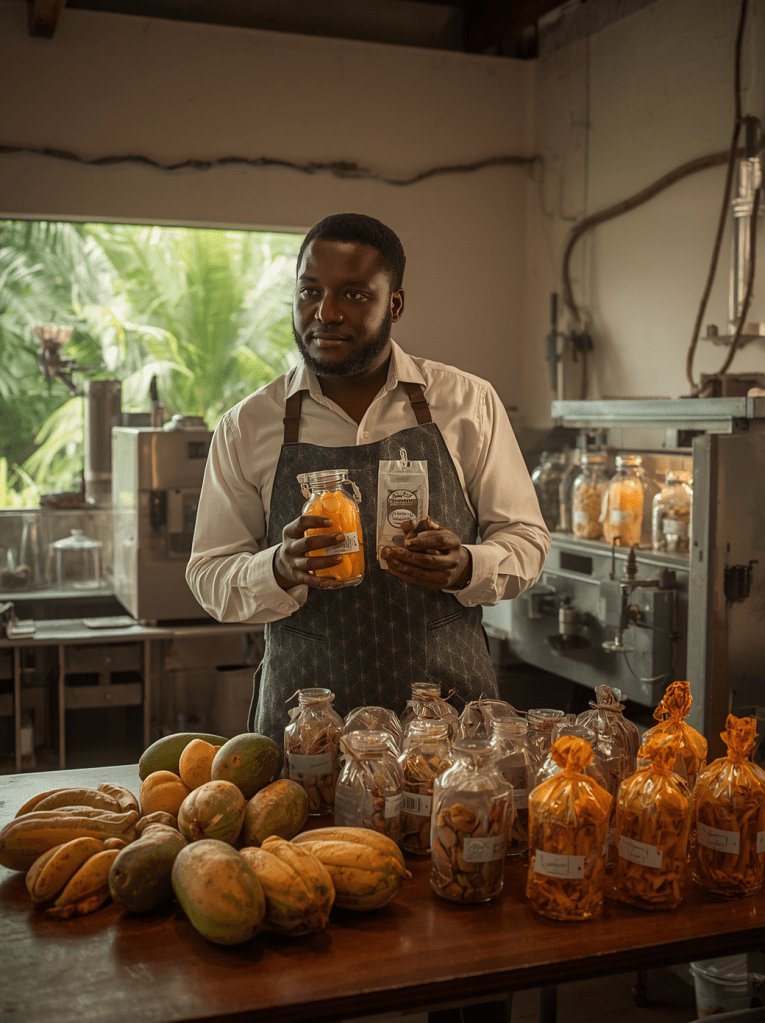
Stop Losing Money to Spoilage. Start Capturing Value.
Every year, Caribbean farmers lose up to 40% of their harvest to spoilage, seasonal gluts, and limited market access. Meanwhile, the same crops — when processed, packaged, and branded correctly — can command 3-10x their raw market value.
This course bridges that gap.
Whether you grow mangoes in Dominica, cocoa in Grenada, spices in St. Vincent, or root provisions in Jamaica, you’ll learn how to transform raw produce into profitable products that sell year-round, reach diaspora markets, and build generational wealth.
No large capital required. No complex equipment needed. Just practical, step-by-step guidance designed for Caribbean small-scale producers.
6
Weeks of Content
21+
Video Lessons
25+
Downloadable Templates
5
Caribbean Case Studies
🎯 COURSE OUTCOMES
By the End of This Course, You Will:
Outcome 1:
🔍 Identify High-Value Processing Opportunities
Match your crops to the most profitable processing methods based on Caribbean market demand and seasonal availability.
Outcome 2:
⚙️ Apply Small-Scale Processing Techniques
Master drying, dehydrating, preserving, fermenting, and packaging while maintaining food safety standards.
Outcome 3:
📋 Design Compliant Product Labels
Create labels that meet CARICOM and national regulatory requirements while telling your Caribbean story.
Outcome 4:
💰 Calculate Profitable Pricing
Set wholesale and retail prices that cover costs, ensure margins, and remain competitive in local and export markets.
Outcome 5:
🏪 Navigate Distribution Channels
Access supermarkets, farmers’ markets, agro-tourism outlets, and diaspora shops with professional positioning.
Outcome 6:
📜 Prepare for Certification
Understand Caribbean food safety regulations (DBSS, BBS, national bureaus) and complete your certification application.
Course Curriculum: 6 Weeks to Product Launch
Self-paced video lessons, practical exercises, downloadable templates, and real Caribbean case studies.
Duration: 3 hours ✓ The Caribbean agricultural paradox: abundance vs. income
✓ Post-harvest losses: the hidden cost of selling raw
✓ The value chain: from farm gate to supermarket shelf
✓ Case studies: Dominican banana chips, Grenadian chocolate, St. Lucian spice blends
✓ Mindset shift: from “farmer” to “agro-entrepreneur”
✓ Practical Exercise: My Farm’s Value Audit
Duration: 3.5 hours
✓ Processing methods overview: drying, freezing, canning, fermenting, extracting
✓ The Caribbean Crop-Processing Matrix
✓ Market research on a budget: validating demand without spending money
✓ The Product Viability Framework (7 critical questions)
✓ Avoiding common mistakes (over-processing, wrong packaging)
✓ Practical Exercise: Product Selection & Validation
Duration: 4 hours
✓ Small-scale processing equipment: what you need (and what you can improvise)
✓ Step-by-step processing demos: dried fruits, hot sauces, spice blends
✓ Food safety fundamentals: HACCP principles for small processors
✓ Caribbean food safety regulations: DBSS, BBS, national bureaus
✓ Calculating yields, shrinkage, and production costs
✓ Practical Exercise: Process Your Product (create a small batch)
Duration: 3.5 hours
✓ Packaging materials for tropical products: glass, plastic, pouches
✓ Shelf life testing and preservation techniques
✓ Label design: mandatory CARICOM elements + branding
✓ Nutritional labeling: how to get it done affordably
✓ Barcodes, batch numbers, and traceability
✓ The certification journey: from application to approval
✓ Practical Exercise: Design Your Product Label
Duration: 3.5 hours
✓ Pricing strategies: cost-plus vs. value-based vs. competitive
✓ Understanding margins: farm gate, wholesale, retail, export
✓ Distribution channels: farmers’ markets, supermarkets, agro-tourism, online, diaspora
✓ Marketing on a budget: social media, storytelling, sampling
✓ The Caribbean brand advantage: heritage, authenticity, quality
✓ Negotiating with buyers and retailers
✓ Practical Exercise: Go-to-Market Plan
Duration: 4 hours
✓ The one-page business plan for agro-processors
✓ Financial projections: startup costs, break-even, 12-month forecast
✓ Funding options: microfinance, agricultural grants, cooperative models
✓ Scaling strategies: from kitchen to commercial facility
✓ Risk management: climate, market, regulatory
✓ Your next 90 days: from course completion to product launch
✓ Capstone Project: My Value-Added Product Launch Plan
👨 Small-Scale Farmers
You grow mangoes, cocoa, spices, root provisions, or other tropical crops. You’re tired of selling raw at low farm-gate prices and losing produce to spoilage.
👩🍳 Aspiring Agro-Processors
You want to launch a food business but don’t know where to start. You need a structured roadmap from concept to certified, market-ready product.
Rural Entrepreneurs
You’re looking to create income-generating opportunities in your community. You want to add value to local harvests and create jobs.
No prior processing experience required. If you have access to crops and commitment to learn, you belong here.
What’s Included in This Course
✓ Lifetime Access
Enroll once, access forever. Learn at your own pace and revisit content whenever you need it.
✓ Downloadable Resources
25+ practical tools including processing recipes, cost calculators, label templates, and certification checklists.
✓ Caribbean Case Studies
Learn from 5 real Caribbean success stories: Dominica’s banana chips, Grenada’s chocolate, St. Lucia’s spices, and more.
✓ Community Forum Access
Connect with other Caribbean farmers and agro-processors, ask questions, share experiences, and find collaborators.
✓ Weekly Cohort Check-Ins
Live Q&A sessions with instructor and peers (all recorded for those who can’t attend live).
✓ Expert Instruction
Content developed and reviewed by professionals with institutional-level expertise in agriculture, food safety, and Caribbean markets.
✓ Certificate of Completion
Receive a digital certificate to showcase on LinkedIn or use when applying for funding/certification.
✓ Pathway to Advanced Learning
This course is your foundation. Graduates get priority access to Term 2 masterclasses and Term 3 fellowships.

📚 REAL CARIBBEAN STORIES
Learn from Those Who’ve Done It
Case Study 1:
Maria’s Mango Empire — Dominica
A small farmer turned seasonal mango gluts into year-round income through dried fruit production. Now exporting to UK diaspora markets and employing 5 community members.
Key Lesson: Start small, validate demand, scale strategically.
Case Study 2:
The Grenada Chocolate Company
A cooperative of cocoa farmers built a globally recognized bean-to-bar brand, keeping 70% of value on the island instead of exporting raw beans.
Key Lesson: Collaboration + quality + storytelling = premium positioning.
Case Study 3:
St. Lucia’s Spice Route Collective
Small farmers standardized spice blends, achieved national certification, and secured supermarket placement across CARICOM.
Key Lesson: Collective action opens doors individual farmers can’t access.

👨 YOUR INSTRUCTOR
Learn from Institutional Expertise
Irvin J Pascal, FCA
Founder, Horizon Bridge Academy
Irvin brings deep institutional expertise in project finance, financial modeling, and investment analysis to Caribbean agribusiness development. As a Fellow of the Institute of Chartered Accountants in England and Wales, he has structured major project financings and advised on investment strategies across multiple sectors, including agriculture and climate-resilient enterprises.
His work across South Africa and Dominica has given him a unique perspective on how to transform small-scale agricultural production into bankable, investable businesses.
Irvin is passionate about equipping Caribbean farmers and agro-entrepreneurs with the financial and strategic tools needed to capture more value from their harvests and build generational wealth.
Credentials:
✓ Fellow of the Institute of Chartered Accountants in England and Wales (FCA)
✓ 30+ years in project finance and business advisory
✓ Expertise in agricultural value chains
✓ Founder of Horizon Bridge Academy
Invest in Your Agricultural Future
Choose the option that works for you. All options include lifetime access, community support, and certificate of completion.
Single Course
$97 one-time
✓ Full course access
✓ All video lessons
✓ 25+ downloadable resources
✓ Community forum access
✓ Certificate of completion
✓ Lifetime updates
Founding Member Bundle
$197
✓ Any 3 Term 1 Courses
✓ Save $94 vs. individual pricing
✓ “Founding Member” digital badge
✓ Priority access to Term 2 courses
✓ Quarterly founder Q&A sessions
✓ All benefits from individual course
Best Value – Limited Time
Payment Plan
3 x $35
✓ Same great course
✓ Spread payments over 3 months
✓ No interest, no fees
✓ Full access from day one
✓ All course materials included
✓ Certificate upon completion
Flexible Payment Option
Secure payment via Stripe or PayPal | 14-day money-back guarantee | Questions? Email info@horizonbridge.academy
Continue Your Journey
This course is your foundation. Here’s where you can go next:
📚 Related Term 1 Courses
- Cook with Confidence: Caribbean Culinary Essentials
- Introduction to Sustainable Trade
- Digital Marketing & E-commerce for Artisans
Starting at: $47-$97 one-time
Agri-Food Value Chain Pathway
Complete sequence from value addition to bankable climate-resilient projects:
- Term 1: Value Addition in Agriculture ✓
- Term 1: Cook with Confidence
- Term 2: Food Product Development
- Term 2: Agri-Tourism Leadership
- Term 3: Bankable Projects for Climate Resilience
Pathway Price: $897 (regularly $1,047)
Term 2 Masterclasses
- Food Product Development (Q1 2027)
- Cultivating Leaders in Agri-Tourism (Q2 2027)
- Financial Modeling for Caribbean SMEs
Starting at: $247-$347
Founding Member Benefit: Complete this course and receive priority access + early-bird pricing on all advanced programs.
Frequently Asked Questions
Q1:
Do I need prior experience in food processing?
No! This course is designed for beginners. We start with the basics and build from there. If you have access to crops (your own or through partnerships) and commitment to learn, you can succeed.
Q2:
What equipment do I need?
You can start with basic kitchen equipment. We provide a detailed equipment checklist with budget-friendly options and improvisation ideas. Many successful Caribbean agro-processors started with minimal equipment.
Q3:
Can I take this course if I don’t grow crops myself?
Absolutely! Many students partner with local farmers or source from markets. The course teaches you how to identify viable products and build supply relationships.
Q4:
Will this course help me get certified?
Yes! We cover Caribbean food safety regulations (DBSS, BBS, national bureaus) in detail and provide certification application roadmaps. You’ll understand exactly what’s required for your country.
Q5:
What if I’m not ready to launch a product yet?
That’s okay! Many students take this course to explore opportunities before investing. You’ll gain valuable knowledge about value chains, market demand, and processing that will inform your decisions.
Q6:
Can I access the course materials after completion?
Yes! You have lifetime access to all course content, including future updates. You can revisit lessons, download updated resources, and stay connected with the community.
Q7:
Do you offer refunds?
Yes! We offer a 14-day money-back guarantee. If you’re not satisfied with the course for any reason, contact us within 14 days of enrollment for a full refund. No questions asked.
Q8:
Can international students enroll?
Yes! While the course focuses on Caribbean context, the principles apply globally. Diaspora professionals and international entrepreneurs are welcome.
Ready to Transform Your Harvest into Profit?
Join Caribbean farmers and agro-processors who are capturing more value from every harvest. Enroll today and start building your product launch plan.
Enroll in 2 Minutes


💳 Pay with Card 💰 Payment Plan Available 🔒 Secure Checkout
🎓 Founding Cohort 2026: Enroll by July 31, 2026 to receive lifetime course updates and Founding Member benefits.

