
🎓 CARIBBEAN QUALIFICATIONS FRAMEWORK | NAB APPLICATION IN PROCESS [Target submission date 10th August 2026
CQF Alignment
Caribbean Qualifications Framework Standards
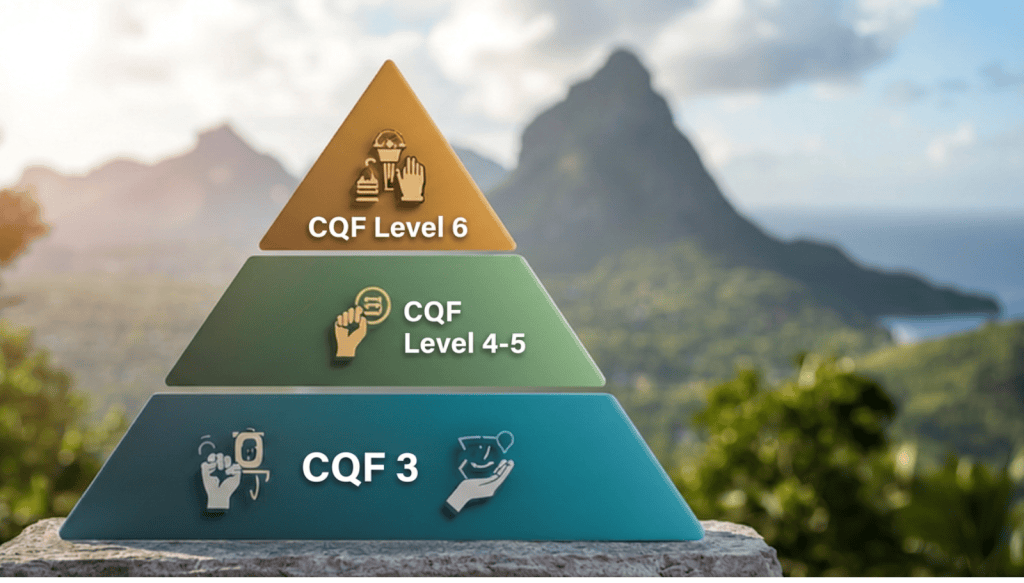
Horizon Bridge Academy programmes are deliberately designed in alignment with the Caribbean Qualifications Framework (CQF), ensuring regional recognition, international portability, and professional excellence. Our three-tier structure maps directly to CQF Levels 3, 4-5, and 6.
📚 REGIONAL STANDARD
Understanding the Caribbean Qualifications Framework
The Caribbean Qualifications Framework (CQF) is the regional standard for qualifications across the Caribbean Community (CARICOM). It ensures that qualifications are comparable, transparent, and recognized throughout the region and internationally.
What CQF Provides:
✓ Transparency: Clear standards for what learners should know and be able to do
✓ Comparability: Qualifications can be compared across Caribbean institutions
✓ Portability: Credentials recognized regionally and internationally
✓ Quality Assurance: Programs meet established academic and professional standards
✓ Progression Pathways: Clear routes from one level to the next
Why It Matters:
CQF alignment ensures that your Horizon Bridge Academy credential is meaningful, respected, and valued by employers, professional bodies, and educational institutions across the Caribbean and beyond.
📊 THREE-TIER STRUCTURE
Horizon Bridge Academy CQF Alignment
Each HBA programme tier is deliberately aligned with specific CQF levels, ensuring progressive skill development and recognized credentials at every stage of your learning journey.
CQF LEVEL 3 | CERTIFICATE
Term 1: Certificate in Caribbean Professional Foundations
CQF Level 3 Standard:
Foundational knowledge and basic skills applicable in familiar contexts under supervision or guidance.
HBA Alignment:
✓ Knowledge: Foundational understanding of sector-specific principles and Caribbean business context
✓ Skills: Basic application of techniques and tools in familiar situations
✓ Competence: Ability to complete structured tasks with some autonomy
✓ Responsibility: Personal accountability for learning and work quality
Learning Outcomes:
Students demonstrate foundational knowledge, apply basic skills in Caribbean business contexts, and progress confidently to advanced study.
HBA Term 1 Programme:
Credential: Certificate in Caribbean Professional Foundations
Notional Learning Hours: 180 hours
Courses: 9 foundational courses
Duration: 4-6 weeks per course (self-paced)
Assessment: Portfolio-based assessments, practical case studies, reflective journals
Entry Requirements: Open enrollment (no prerequisites)
Progression: Direct entry to Term 2 (CQF Level 4-5)Sample Courses:
• Cook with Confidence: Caribbean Culinary Essentials
• Introduction to Value Addition in Agriculture
• Operational Excellence in Island Clinics
• Digital Marketing & E-commerce for Artisans
CQF LEVEL 4-5 | DIPLOMA
Term 2: Diploma in Sector Specialist Leadership
CQF Level 4-5 Standard:
Advanced knowledge and skills with ability to analyze, evaluate, and apply in complex contexts with limited supervision.
HBA Alignment:
✓ Knowledge: Advanced understanding of sector dynamics and international frameworks
✓ Skills: Analysis of complex scenarios and development of strategic solutions
✓ Competence: Ability to lead projects and teams with professional judgment
✓ Responsibility: Accountability for decisions and team outcomes
Learning Outcomes:
Students analyze complex business scenarios, develop strategic solutions for sector challenges, and demonstrate advanced professional competence.
HBA Term 2 Programme:
Credential: Diploma in Sector Specialist Leadership
Notional Learning Hours: 240 hours
Pillars: 7 specialist pillars
Duration: 8-10 weeks per masterclass
Assessment: Live case presentations, industry projects, peer-reviewed work
Entry Requirements: Term 1 completion OR 3+ years professional experience (RPL)
Progression: Direct entry to Term 3 (CQF Level 6)
Sample Pillars:
• Strategic Vision & Ethical Governance
• Financial Acumen & Resource Stewardship
• Innovation & Global Trade Facilitation
• Cultural Intelligence & Heritage as Advantage
CQF LEVEL 6 | ADVANCED FELLOWSHIP
Term 3: Advanced Fellowship in Bankable Project Development
CQF Level 6 Standard:
Mastery-level knowledge and skills with ability to synthesize, innovate, and lead in complex, unpredictable contexts.
HBA Alignment:
✓ Knowledge: Mastery-level understanding across multiple domains and institutional funding mechanisms
✓ Skills: Synthesis of complex information and creation of innovative solutions
✓ Competence: Development of bankable projects meeting DFI requirements
✓ Responsibility: Strategic leadership and transformational change management
Learning Outcomes:
Students synthesize complex information, create innovative solutions for Caribbean challenges, and develop investor-ready bankable projects.
HBA Term 3 Programme:
Credential: Advanced Professional Certificate
Notional Learning Hours: 600 hours
Tracks: 3 specialized fellowship tracks
Duration: 12-week intensive fellowship
Assessment: Externally examined capstone, live investor presentation, viva voce defense
Entry Requirements: Term 2 completion OR 5+ years senior leadership experience + application
Outcome: Investor-ready bankable project
Fellowship Tracks:
• Bankable Projects Masterclass: From Vision to DFI Capital
• Mastering Bankable Projects for Climate Resilience
• Strategic Planning for Private Health Ventures
🎯 COMPETENCY FRAMEWORK
Learning Outcomes Mapped to CQF Standards
Every Horizon Bridge Academy programme includes clearly defined learning outcomes that align with Caribbean Qualifications Framework descriptors for knowledge, skills, and competence.
CQF Level 3 (Term 1):
✓ Foundational knowledge of sector-specific principles and practices
✓ Understanding of Caribbean business environment and regional dynamics
✓ Basic financial and operational concepts
✓ Introduction to professional standards and ethics
✓ Awareness of Caribbean cultural and post-colonial contexts
CQF Level 3 (Term 1):
✓ Apply basic techniques and tools in familiar contexts
✓ Complete practical assignments independently
✓ Use standard business tools and software
✓ Communicate professionally in writing and verbally
✓ Conduct basic research and analysis
CQF Level 3 (Term 1):
✓ Professional work ethic and time management
✓ Basic problem-solving and critical thinking
✓ Collaborative learning and teamwork
✓ Cultural awareness and sensitivity
✓ Commitment to continuous learning
CQF Level 4-5 (Term 2):
✓ Advanced knowledge of sector dynamics and industry trends
✓ Understanding of regional and international frameworks (CARICOM, CSME, IFRS)
✓ Strategic management concepts and organizational behavior
✓ ESG and sustainability principles
✓ Caribbean economic development priorities
CQF Level 4-5 (Term 2):
✓ Analyze complex business scenarios and identify key issues
✓ Develop strategic solutions and implementation plans
✓ Lead projects and teams effectively
✓ Apply advanced technical skills in sector-specific contexts
✓ Conduct comprehensive market and feasibility analysis
CQF Level 4-5 (Term 2):
✓ Ethical decision-making and integrity
✓ Advanced critical thinking and analytical reasoning
✓ Stakeholder management and communication
✓ Cultural intelligence and cross-cultural competence
✓ Leadership and team management
CQF Level 6 (Term 3):
✓ Mastery-level knowledge across multiple domains
✓ Deep understanding of institutional funding mechanisms (DFIs, climate funds)
✓ Advanced financial modeling, valuation, and investment analysis
✓ Innovation and transformation frameworks
✓ Caribbean development challenges and opportunities
CQF Level 6 (Term 3):
✓ Synthesize information from multiple sources and disciplines
✓ Create innovative solutions for complex Caribbean challenges
✓ Develop bankable projects meeting DFI requirements
✓ Defend proposals before expert panels with confidence
CQF Level 6 (Term 3):
✓ Transformational leadership and strategic vision
✓ Executive presence and professional influence
✓ Legacy mindset and social responsibility
✓ Innovation and entrepreneurial thinking
✓ Systems thinking and complexity management
📝 ASSESSMENT STANDARDS
Assessment Methods Aligned with CQF
Our assessment framework is designed to evaluate competency at each CQF level, ensuring that graduates demonstrate the knowledge, skills, and capabilities expected at their qualification level.
Assessment Principles
Validity:
Assessments measure what they claim to measure — actual professional competency at the appropriate CQF level in Caribbean contexts.
Reliability:
Consistent assessment standards across all cohorts, with clear marking criteria aligned to CQF descriptors and moderation processes.
Authenticity:
Real-world tasks that mirror actual professional work at each level — from basic applications (Level 3) to strategic leadership (Level 6).
Transparency:
Clear assessment criteria provided upfront with detailed rubrics mapped to CQF learning outcomes. Students know exactly what’s expected.
Fairness:
Multiple assessment methods accommodate different learning styles. Reasonable adjustments available for students with disabilities.
Assessment Methods by CQF Level:
CQF Level 3 (Term 1):
Portfolio assessments (40%), practical case studies (30%), reflective journals (15%), knowledge quizzes (15%)
CQF Level 4-5 (Term 2):
Live case presentations (30%), industry-focused projects (30%), peer-reviewed work (20%), strategic analysis reports (20%)CQF Level 6 (Term 3):
Comprehensive feasibility study – externally examined (40%), sophisticated financial model with DCF analysis (30%), live investor presentation to expert panel (20%), viva voce oral defense (10%)
✅ QUALITY ASSURANCE
CQF Quality Assurance Mechanisms
Horizon Bridge Academy maintains rigorous quality assurance to ensure assessments remain aligned with CQF standards and continue to measure competency effectively.
Quality Mechanisms
Internal Moderation:
✓ All assessments reviewed by Academic Director before release
✓ Sample marking reviewed for consistency with CQF descriptors
✓ Assessment criteria validated against CQF learning outcomes
✓ Regular calibration of marking standards
External Examination:
✓ Term 3 capstone projects examined by independent industry experts
✓ External examiners verify alignment with CQF Level 6 standards
✓ External benchmarking against international professional standards
✓ Input from 12 ICAEW specialist communities
Continuous Review:
✓ Annual assessment review for CQF alignment
✓ Student feedback on assessment fairness and relevance
✓ Graduate employer feedback on competency demonstration
✓ Updates based on CQF framework revisions
CQF Compliance Statement
“All Horizon Bridge Academy assessments are deliberately designed to measure competency at the appropriate CQF level, ensuring that graduates possess the knowledge, skills, and capabilities expected by employers, professional bodies, and educational institutions.”
⏱️ LEARNING TIME
Notional Learning Hours Aligned with CQF
CQF uses notional learning hours to indicate the typical time required to achieve learning outcomes. Horizon Bridge Academy programmes specify hours that align with CQF standards for each level.
CQF LEVEL 3
Term 1: 180 Hours
CQF Standard: 180 notional learning hours for Certificate level
HBA Programme:
✓ 9 foundational courses
✓ 40-60 hours per course
✓ Mix of guided learning, self-study, and assessment
✓ Typical completion: 4-6 weeks per course
What’s Included:
• Video lessons and content review
• Practical exercises and case studies
• Assessment preparation and completion
• Peer collaboration and discussion
• Reflective learning activities
CQF LEVEL 4-5
Term 2: 240 Hours
CQF Standard: 240 notional learning hours for Diploma level
HBA Programme:
✓ 7 specialist pillars
✓ 80-100 hours per masterclass
✓ Combination of self-paced and live learning
✓ Typical completion: 8-10 weeks per masterclass
What’s Included:
• Self-paced video content
• Live workshops and case discussions
• Industry project development
• Peer review and collaboration
• Assessment and portfolio development
CQF LEVEL 6
Term 3: 600 Hours
CQF Standard: 600 notional learning hours for Advanced Fellowship level
HBA Programme:
✓ 3 specialized fellowship tracks
✓ 600 hours over 12 weeks
✓ Intensive hybrid delivery
✓ Typical completion: 12-week intensive
What’s Included:
• Bi-weekly live masterminds
• 1:1 mentorship sessions
• Capstone project development
• External examination preparation
• Investor presentation and defense
Learning Hours Statement
Notional learning hours include all learning activities: guided learning (videos, workshops), independent study, assessment preparation, and practical application. Hours align with CQF standards to ensure regional and international recognition.
📈 PROGRESSION
CQF-Aligned Progression Pathways
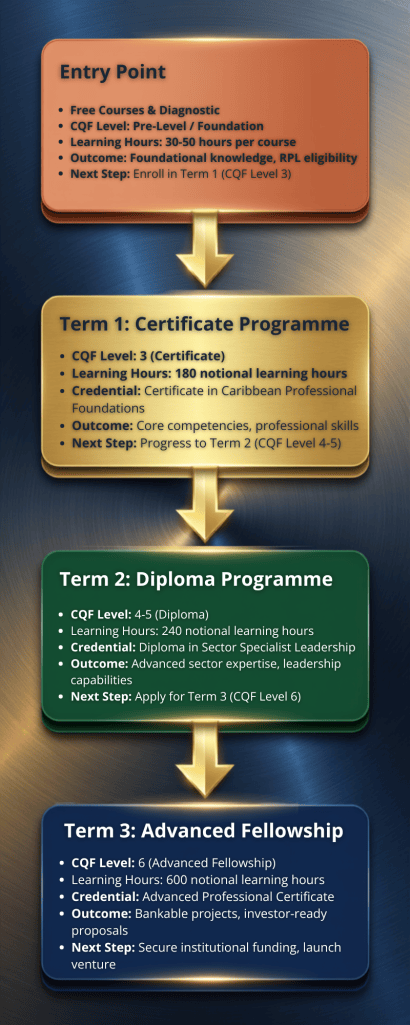
Progression Benefits
Flexibility:
✓ Study at your own pace
✓ Exit with credentials when ready
✓ Return to advance when circumstances allow
✓ Recognition of Prior Learning (RPL) available
Value:
✓ Each credential has standalone value
✓ Immediate application of skills
✓ Progressive investment aligned with outcomes
✓ Stackable qualificationsRecognition:
✓ CQF-aligned credentials
✓ Internationally benchmarked
✓ Portable across Caribbean region
✓ Recognized by employers and professional bodies
INTERNATIONAL STANDARDS
Beyond CQF: International Benchmarking
While aligned with Caribbean Qualifications Framework, Horizon Bridge Academy programmes are also benchmarked against international professional standards to ensure global competitiveness.
International Alignment:
ICAEW Professional Standards:
Our founder’s active membership in 12 ICAEW specialist communities ensures curriculum reflects current international accounting, governance, and professional standards.
ACCA Qualification Frameworks:
Programme content references Association of Chartered Certified Accountants qualification frameworks and international best practices.
Development Finance Institutions:
Term 3 Fellowship projects are designed to meet the requirements of CDB, IDB, Green Climate Fund, and other development finance institutions.
CARICOM & CSME:
Alignment with Caribbean Community frameworks, CARICOM Single Market and Economy (CSME), and regional economic integration priorities.
📊 QUALITY INDICATORS
CQF Quality Indicators
We track multiple quality indicators to ensure programmes meet CQF standards and deliver exceptional value.
Quality Metrics:
Learning Outcomes Achievement:
✓ Percentage of students achieving stated learning outcomes
✓ Competency demonstration rates at each CQF level
✓ Assessment pass rates aligned with CQF standards
Student Satisfaction:
✓ Student feedback on learning experience
✓ Perceived relevance to Caribbean context
✓ Confidence in skill application
Graduate Outcomes:
✓ Employment rates and career advancement
✓ Further study progression
✓ Employer satisfaction with graduate competencies
✓ Professional body recognition
External Validation:
✓ External examiner reports
✓ Professional body feedback
✓ Industry advisory input
✓ NAB accreditation status
Transparency Commitment:
“We publish our CQF alignment openly because we’re confident in our quality. Our commitment to Caribbean Qualifications Framework standards exceeds compliance — it’s foundational to our mission of delivering world-class education rooted in Caribbean context.”
✅ ACCREDITATION STATUS
NAB Application & CQF Compliance
Horizon Bridge Academy will [on 10th August 2026] submit comprehensive application for institutional recognition with the National Accreditation Body (NAB) of the Commonwealth of Dominica, demonstrating full CQF alignment.
Application Status
Status: Application Under Review
CQF Alignment Documentation Submitted:
✓ Programme specifications mapped to CQF Levels 3, 4-5, and 6
✓ Learning outcomes aligned with CQF descriptors
✓ Assessment strategies validated against CQF standards
✓ Notional learning hours compliant with CQF requirements
✓ Quality assurance mechanisms for CQF compliance
✓ Progression pathways clearly defined
NAB Requirements Met:
✓ Academic standards aligned with regional frameworks
✓ Quality assurance systems established
✓ Student support services in place
✓ Qualified academic leadership (FCA)
✓ External examination protocols
✓ Continuous improvement processes
Processing Timeline:
• Standard processing: Minimum 10 working days
• Express option: 48 hours (EC$600 fee)
• Application reference: [To be assigned upon submission]
What CQF Alignment Means for Students (Light Gold tint card, padding 24px, max-width 900px, centered):You Can Enroll With Confidence Because:
✓ Programmes deliberately designed to meet CQF standards
✓ Credentials recognized across Caribbean region
✓ Learning outcomes clearly defined and assessed
✓ Quality assurance frameworks in place
✓ International benchmarking ensures global relevance
✓ Clear progression pathways to advanced study
Contact for CQF Information:
📧 info@horizonbridge.academy
Start Your CQF-Aligned Learning Journey
Join Caribbean professionals who are building world-class skills through CQF-aligned programmes. Start with our free diagnostic and discover your pathway to professional success.
Enrollment Support
Questions about CQF alignment? Contact our Academic Affairs team at info@horizonbridge.academy or schedule a 15-minute consultation.
Academic Leadership & CQF Alignment
All Horizon Bridge Academy programmes are designed and overseen by Irvin Pascal, FCA, Fellow of the Institute of Chartered Accountants in England and Wales, with active membership in 12 specialist communities including:
ICAEW Communities:
• Corporate Governance
• Academia & Education
• Sustainability & Climate Change
• Global Trade
• Valuation
• Manufacturing
• Healthcare
• Tourism & Hospitality
• Farming & Rural Business
• Small & Micro Business
• Diversity & Inclusion
• Black Members Community
Quality Assurance Statement:
Programmes are aligned with Caribbean Qualifications Framework (CQF) Levels 3, 4-5, and 6, and incorporate international professional standards. Application for institutional recognition is currently under review by the National Accreditation Body (NAB) of the Commonwealth of Dominica.
CQF-Aligned Programmes
FCA Academic Leadership
NAB Application in Process
12 ICAEW Communities
International Benchmarking
Quality Assured

